Yuanyuan Gao

Job market paper

The Retreat of Local Banking: Spillover Effects on SME Credit

with Lorenzo Ferrante · Paper (PDF)

As technological transformation leads banks to retreat from local markets, in a frictionless credit market, firms can be expected to rely on other lenders to step in as substitutes. Instead, using Italian loan-level data with lenders’ default forecasts, we find that when a bank leaves a municipality, an affected firm’s incumbent co-lenders act as complements and cut credit as well. One year after the exit, incumbent co-lenders account for 69 percent of the decline in the firm’s credit from its incumbent banks. Relative to their other borrowers in the same municipality, they cut credit to affected firms by an extra 4.2 percent. The cut reflects both an increase in borrower risk and a deterioration of lender information: affected firms default more often, and the co-lenders’ default forecasts become less accurate. Co-lenders with a branch in the municipality lose little forecast accuracy and cut about half as much as those without one, implying that lost information accounts for 29 percent of the cut. Lending by a firm’s other banks is thus complementary to local banks’ presence, implying that branch closures generate negative externalities across the wider credit market.
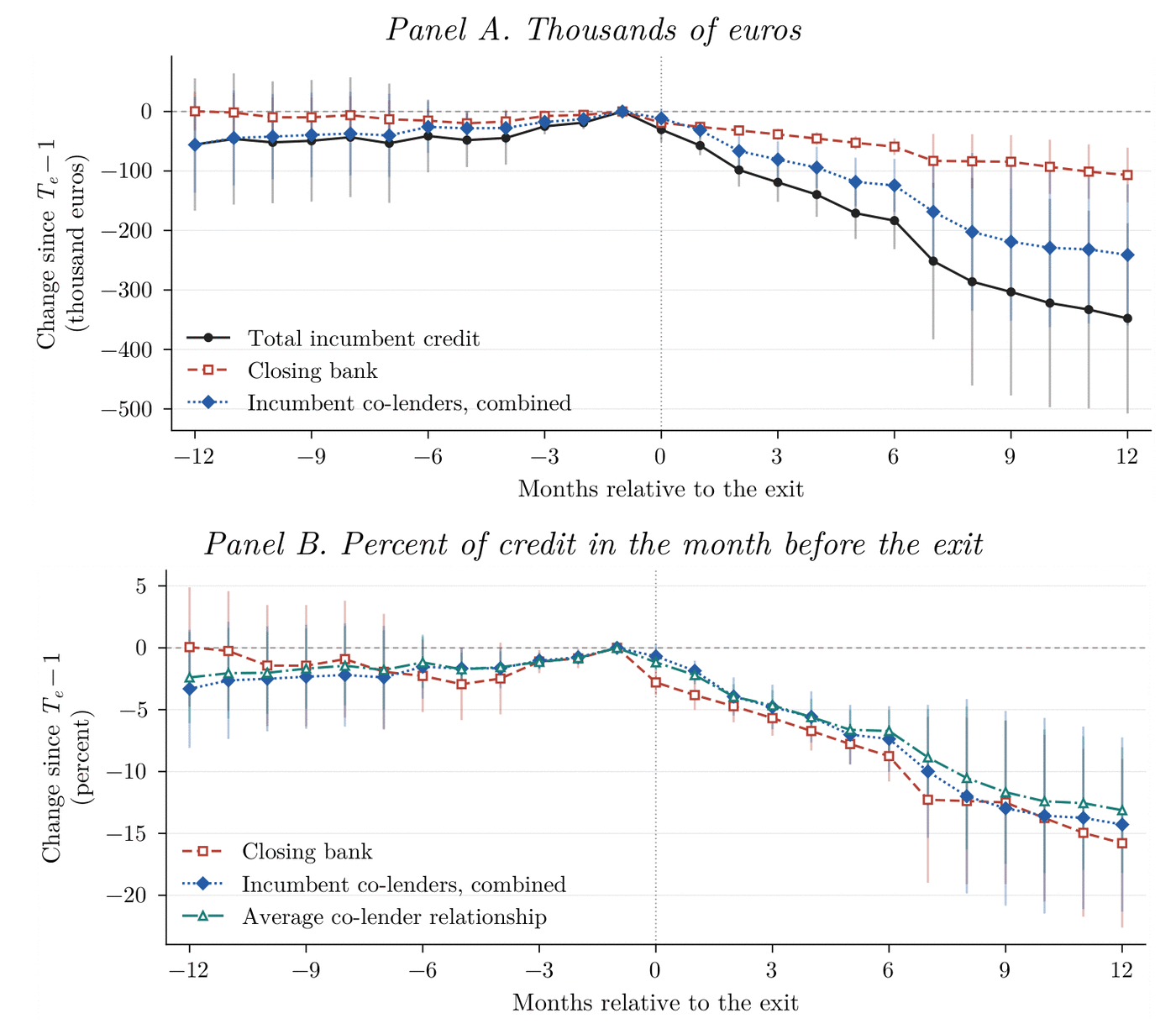
Event-study chart: after the exit, credit to affected firms falls both from the closing bank and, by more in euros, from their incumbent co-lenders
Credit to affected firms from the closing bank and from their incumbent co-lenders in the 12 months around the exit, relative to the month before the exit, with 95% confidence intervals (1,829 exits). Panel A in thousands of euros; Panel B in percent of credit in the month before the exit.

Working papers

Impeded Flights in European Sovereign Debt Markets

with Lorenzo Ferrante, Per Östberg and Thomas Richter

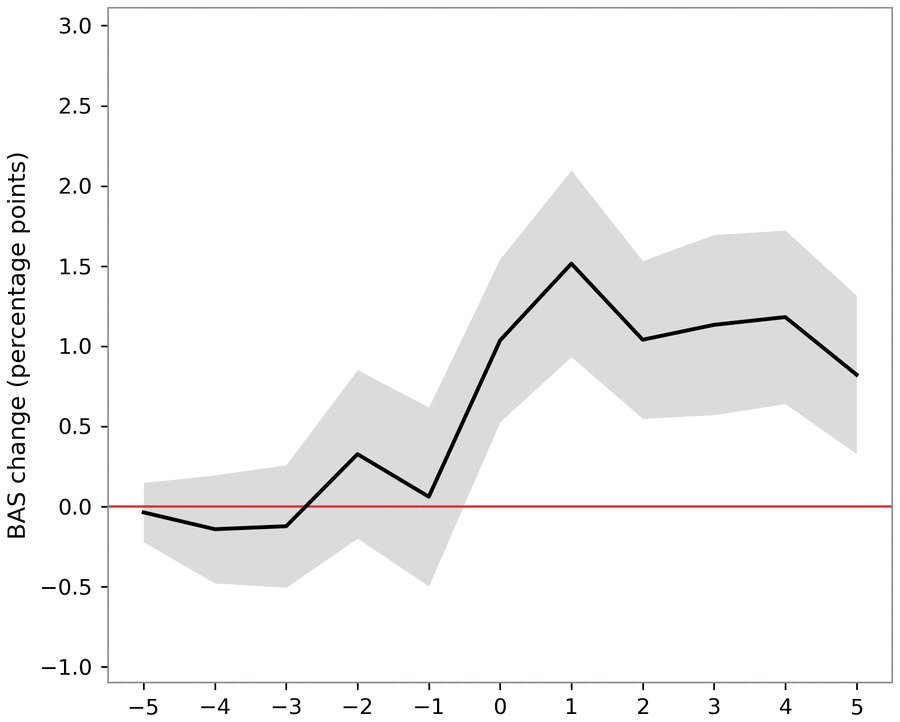
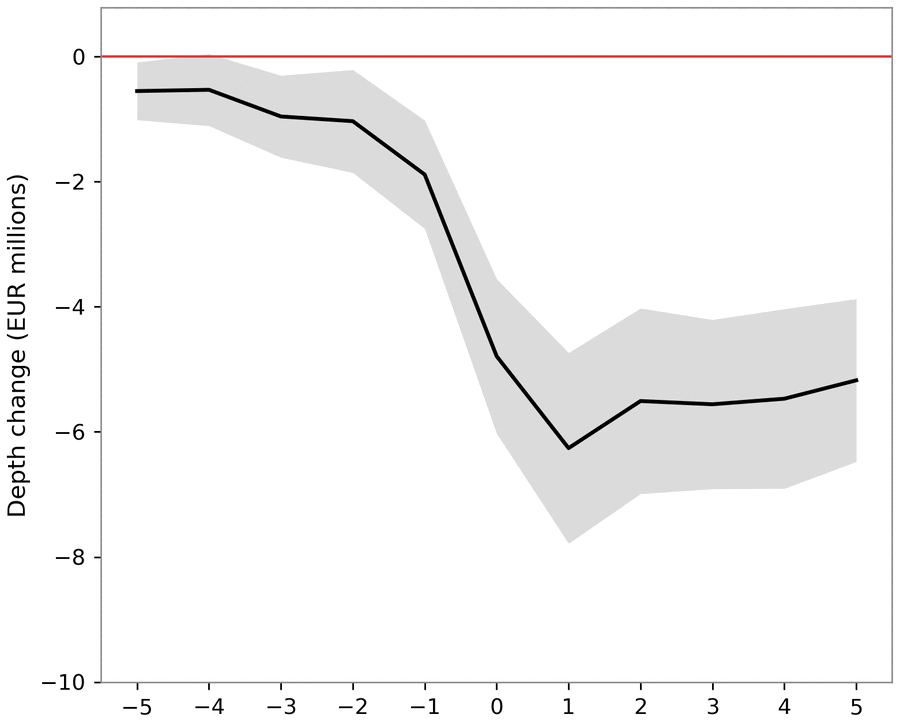
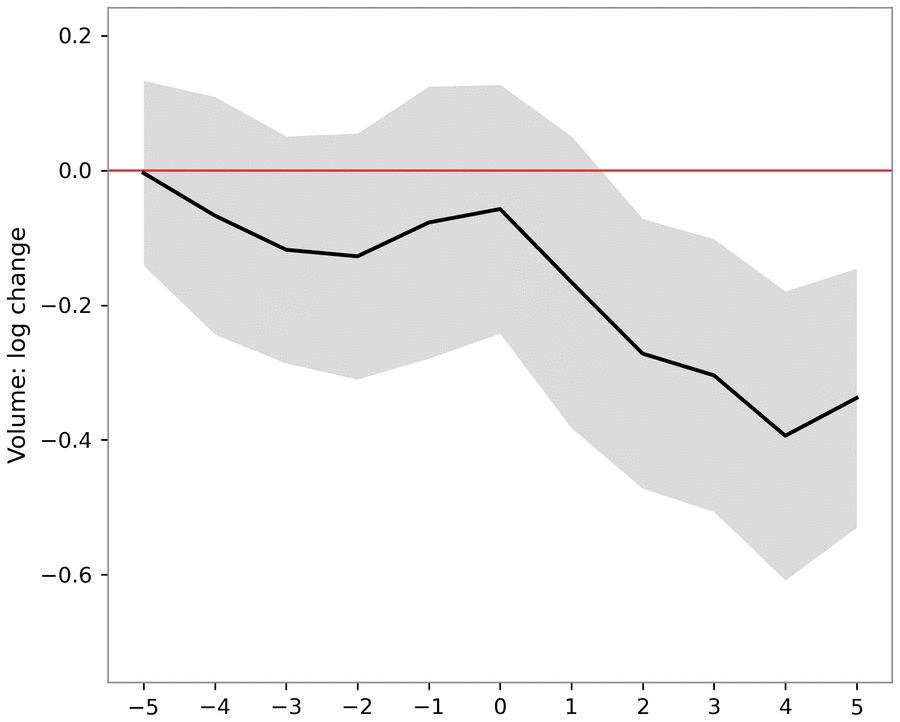
Theory predicts that yield shocks trigger flights from risky to safe assets. In the European sovereign bond market, these flights are impeded: after stress events, trading volume falls by 21–31% over the following week rather than increasing. The mechanism is a collapse in liquidity supply: bid-ask spreads nearly double and market depth falls by about a fifth. Exploiting that the same bond trades on both a domestic and a pan-European MTS platform, we show that spreads widen more and volume drops more on the domestic platform, where market makers hold more of their own sovereign’s debt. We also provide evidence that these secondary-market freezes contributed to the rise in banks’ home bias during the crisis. Bank-dealers’ concentrated exposure to sovereign risk can freeze a central secondary market when rebalancing is most needed.

Trading volume (log change), bid-ask spread and market depth of event countries from five trading days before to five trading days after a flight event (day 0), with 95% confidence intervals; the red line marks zero. Events at the intermediate severity threshold (κ = 1.5); the paper shows all three thresholds.

Does Competition Make Banks Better Informed?

with Lorenzo Ferrante

Banking theory has long debated whether competition erodes banks’ private information about their borrowers, but this information is rarely observed. We use AnaCredit, in which several banks report their own probability of default (PD) for the same firm in the same month. Disagreement among these PDs predicts default beyond the lenders’ consensus and thus carries private information. PDs rank borrowers less well in more competitive markets. Comparing banks that lend to the same firm gives a different angle. A bank’s PD relative to its co-lenders’ predicts default on its own loans more strongly where more banks compete. Relationship lenders’ informational advantage does not diminish with competition. Competition does not appear to erode banks’ private information.

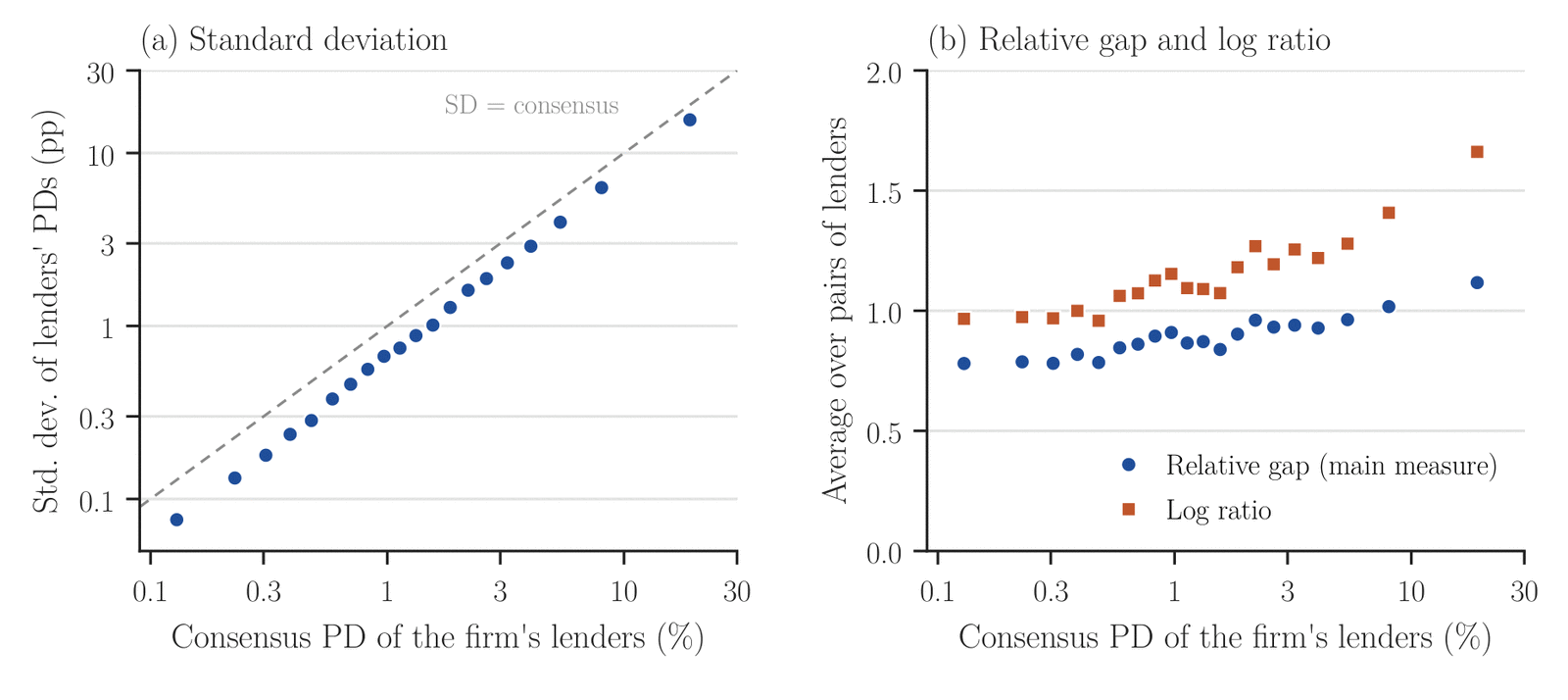
Two scatter plots of lender disagreement against the consensus PD: the standard deviation of PDs rises with risk, while the relative gap stays much flatter
Disagreement among a firm’s lenders across levels of risk: 1.07 million firm–months with at least two lenders reporting PDs, in twenty groups by the lenders’ consensus PD. (a) The standard deviation of lenders’ PDs rises almost in proportion to the consensus PD. (b) The relative gap, the paper’s disagreement measure, rises far less, so it does not simply mirror the firm’s risk.

Work in progress

Winners Are Not Cursed

with Lorenzo Ferrante

Classic theory warns that winning a contested borrower is bad news, because the winner is the most optimistic lender (Broecker, 1990; Shaffer, 1998). Preliminary results show that optimism can nonetheless carry information: conditional on the lenders’ average PD, a lower PD from a firm’s most optimistic lender predicts lower default, while the most pessimistic lender’s PD adds no predictive power. The project asks when a winner’s optimism reflects private information that outweighs the winner’s curse, and separates the curse from search-based adverse selection, which arises when riskier firms approach more banks.